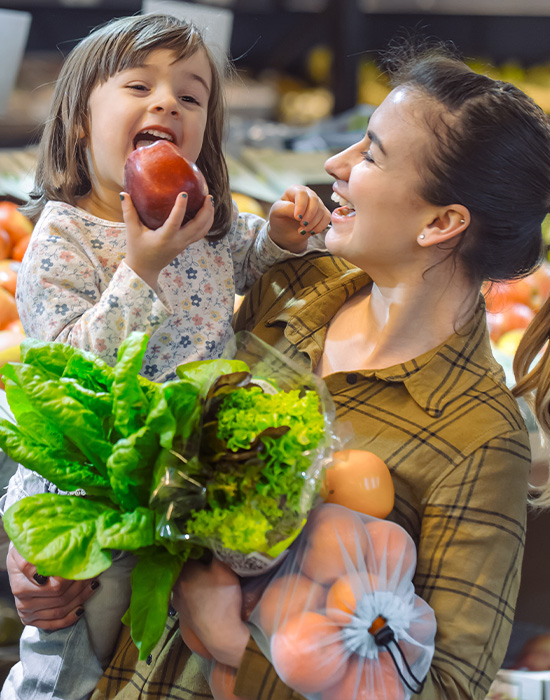

Let’s go to a place my husband would consider very scary—the inner workings of my mind and how I make a decision about when, where and how I shop for grocery items for my family. I’m suggesting we take this journey together because of an interesting finding in the 2019 U.S. Grocery Shopper Trends report—the beginning of a plateau in the reach of online grocery shopping in part due to a flat-trend from Millennials.
<p>By Kelli Windsor, Director, Digital Communications, Food Marketing Institute<br /> <img src="https://www.fmi.org/images/default-source/photos-for-staff-use/produce/picture09.tmb-large-350-.jpg?sfvrsn=ce9e406e_2" data-displaymode="Thumbnail" alt="Picture09" title="Picture09" style="float: right; margin: 10px;" /></p> <p>Let’s go to a place my husband would consider very scary—the inner workings of my mind and how I make a decision about when, where and how I shop for grocery items for my family. I’m suggesting we take this journey together because of an interesting finding in the <a href="https://www.fmi.org/our-research/research-reports/u-s-grocery-shopper-trends">2019 <em>U.S. Grocery Shopper Trends</em></a> report—the beginning of a plateau in the reach of online grocery shopping in part due to a flat-trend from Millennials.</p> <h5>A Look at the Plateau</h5> <p>According to <em>Trends</em>, 33% of grocery shoppers have used an online-only retailer for their shopping needs at least occasionally. The reach of online retail has expanded among Gen X with 40% utilizing these options in 2019 vs. 29% in 2018. Meanwhile Millennials’ online grocery shopping habits have remained level—43% utilizing them in 2017 and 2018 and 45% utilizing them in 2019.</p> <p>However, Millennials have a higher frequency of using online grocery shopping than any other age group. So, the growth for the online channel seems likely to come from enhanced frequency instead of greater reach.</p> <p>Breaking it down further by looking at the <a href="https://www.fmi.org/forms/store/ProductFormPublic/u-s-grocery-shopper-trends-2019-data-tables"><em>Trends</em> data tables</a>, Millennials with kids verses Millennials without kids display similar habits:</p> <div style="text-align: center;"> <table border="1" cellspacing="0" cellpadding="0"> <tbody> <tr> <td colspan="3" valign="top" style="width: 516px;"> <p style="text-align: center;"><strong>Frequency of Shopping Online-Only/Online-Primarily Retailers for Millennials with and without Kids</strong></p> </td> </tr> <tr> <td valign="top" style="width: 138px;"> <p> </p> </td> <td valign="top" style="width: 180px;"> <p><strong>Millennials With Kids</strong></p> </td> <td valign="top" style="width: 198px;"> <p><strong>Millennials Without Kids</strong></p> </td> </tr> <tr> <td valign="top" style="width: 138px;"> <p><strong>At least Occasionally</strong></p> </td> <td valign="top" style="width: 180px;"> <p style="text-align: center;">50%</p> </td> <td valign="top" style="width: 198px;"> <p style="text-align: center;">42%</p> </td> </tr> <tr> <td valign="top" style="width: 138px;"> <p><strong>At least Fairly Often</strong></p> </td> <td valign="top" style="width: 180px;"> <p style="text-align: center;">28%</p> </td> <td valign="top" style="width: 198px;"> <p style="text-align: center;">16%</p> </td> </tr> <tr> <td valign="top" style="width: 138px;"> <p><strong>Almost Every Time</strong></p> </td> <td valign="top" style="width: 180px;"> <p style="text-align: center;">11%</p> </td> <td valign="top" style="width: 198px;"> <p style="text-align: center;">3%</p> </td> </tr> </tbody> </table> </div> <p> </p> <p> </p> <h5>A Glimpse Inside My Millennial Mom Mind</h5> <p>These findings cause me to pause and consider what is happening in my head when I choose to shop for an item. So, if you’ll allow me, I’ll take a moment and go down this rabbit hole and see if my thought process supports the trends.</p> <p>First, the shopping process, for me, starts with the item. If I need, say, a fresh produce item I likely go to the grocery list and write it down intending it for an in-store purchase. If the item my family needs is more of a specialty item—let’s say capers—I probably also write it on the grocery list, but this scale in my head starts to sway back and forth. I begin considering:</p> <ul> <li>What are our family plans for the week?</li> <li>Do I have time for more than one grocery trip, since I know my primary store doesn’t carry capers?</li> <li>Are there things I’m already considering purchasing online that might not be grocery related and I could just add the capers to the order?</li> <li>Which option will save me money and time?</li> </ul> <p>That last one ends up being the big tilter of the scale, and often the deciding factor in how the capers makes it to my house. Often, I’m willing to forgo time to save money and I don’t think I’m alone in this. Millennials with kids grocery shop an average of 6.4 retailers in the past 30 days. Trust me, we’re not doing this because it makes our lives easier—we’re looking for more than just that. We are weighing this scale in our heads, and for many it might come down to price and efficiency, but for more and more the number of factors being placed on the scale are increasingly complex including questions of health, sustainability, transparency and more. </p> <h5>Some Considerations</h5> <p>I realize I’m only one Millennial mom and, <a href="https://www.fmi.org/blog/view/fmi-blog/2018/07/16/why-this-millennial-mom-is-slow-to-adopt-online-grocery-shopping">I’ve written previously about my family’s online grocery shopping verses in-store grocery shopping</a>, so I might not fit every trend. However, I do think a lot of Millennial parents are weighing several factors when they are deciding not just on a product, but also on the experience they prefer to have as they procure that product. Food retailers have an opportunity to stack the scale by listening to their shoppers’ needs and offering options, information and memorable experiences.</p> <a href="https://www.fmi.org/our-research/research-reports/u-s-grocery-shopper-trends" class="button-secondary">Download 2019 U.S. Grocery Shopper Trends </a>
Powered by Versicherungsvergleich